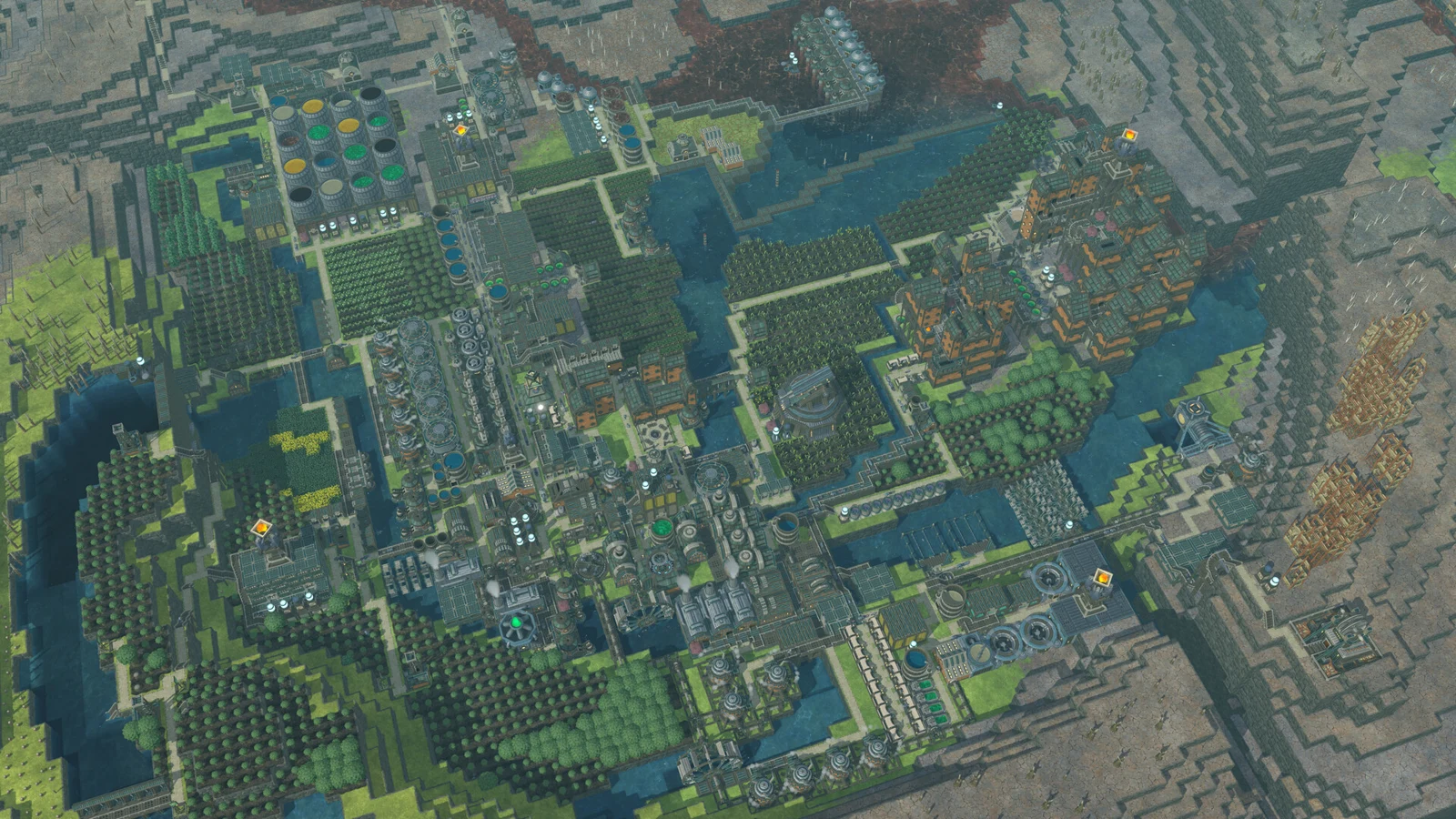
Follow the water beyond the settlement
A river in Timberborn is both a resource and a moving connection between places. Before placing a barrier, follow its route through the map. Notice where it narrows, where the banks rise and where a shallow branch approaches the land you want to use. A wall will change that relationship, so it helps to understand what you are changing first.
Look downstream as well as upstream. A convenient construction point near the settlement may affect water farther away. The first sketch should show a source, a route through the working area and an exit. Without that last part, a tidy-looking structure can become a blockage whose consequences appear somewhere you were not watching.
Separate drinking water from irrigation
Stored drinking water and water remaining in the landscape serve related but different needs. A full tank does not by itself keep a field irrigated, while a visible river does not prove that collection and storage are keeping up with the colony. Read both parts of the system before deciding which construction is urgent.
This distinction makes an early objective clearer. You may need to improve the supply reaching pumps, preserve water beside productive land or expand stored reserves. Those projects can support each other, but they are not interchangeable. Name the need first. A small targeted improvement is easier to understand than a large river alteration built in the hope that it will solve every shortage at once.
Plan around change, not a single view
The wet-season river is not the only condition the design will face. Drought changes the inflow, and retained water still has to support the uses you have built around it. Watch how the landscape behaves across a cycle rather than deciding that a structure works because it looks full immediately after construction.
Mark a few places to inspect: the upstream pool, the intended irrigated area and the downstream continuation. Looking at the same locations makes changes easier to compare. You are learning where the system loses usefulness first. That observation can guide the next adjustment more effectively than increasing the height of every barrier without understanding the limiting part.
Build a small experiment with an exit
Choose a change whose effect you can observe without redesigning the whole colony. A manageable barrier or channel adjustment provides a clearer lesson than several simultaneous projects. Keep the rest of the river readable and leave a way to respond if the result is different from what you expected.
Before construction finishes, describe the intended effect in plain language. You might want a particular pool to remain wet longer or an outlet to let excess water continue downstream. Then inspect that exact relationship after the change. The drawing is a hypothesis about the game’s water system. Watching the result is what turns the hypothesis into useful engineering knowledge.
Keep the notebook tied to a place
Record the section of river, the construction you changed and the condition under which you observed it. Include a question for the next cycle rather than announcing a universal solution. A design that suits one landscape and colony demand may need different choices elsewhere. The notebook becomes useful because it preserves how the settlement learned to live with this river, not because it pretends every map can be solved by the same wall.