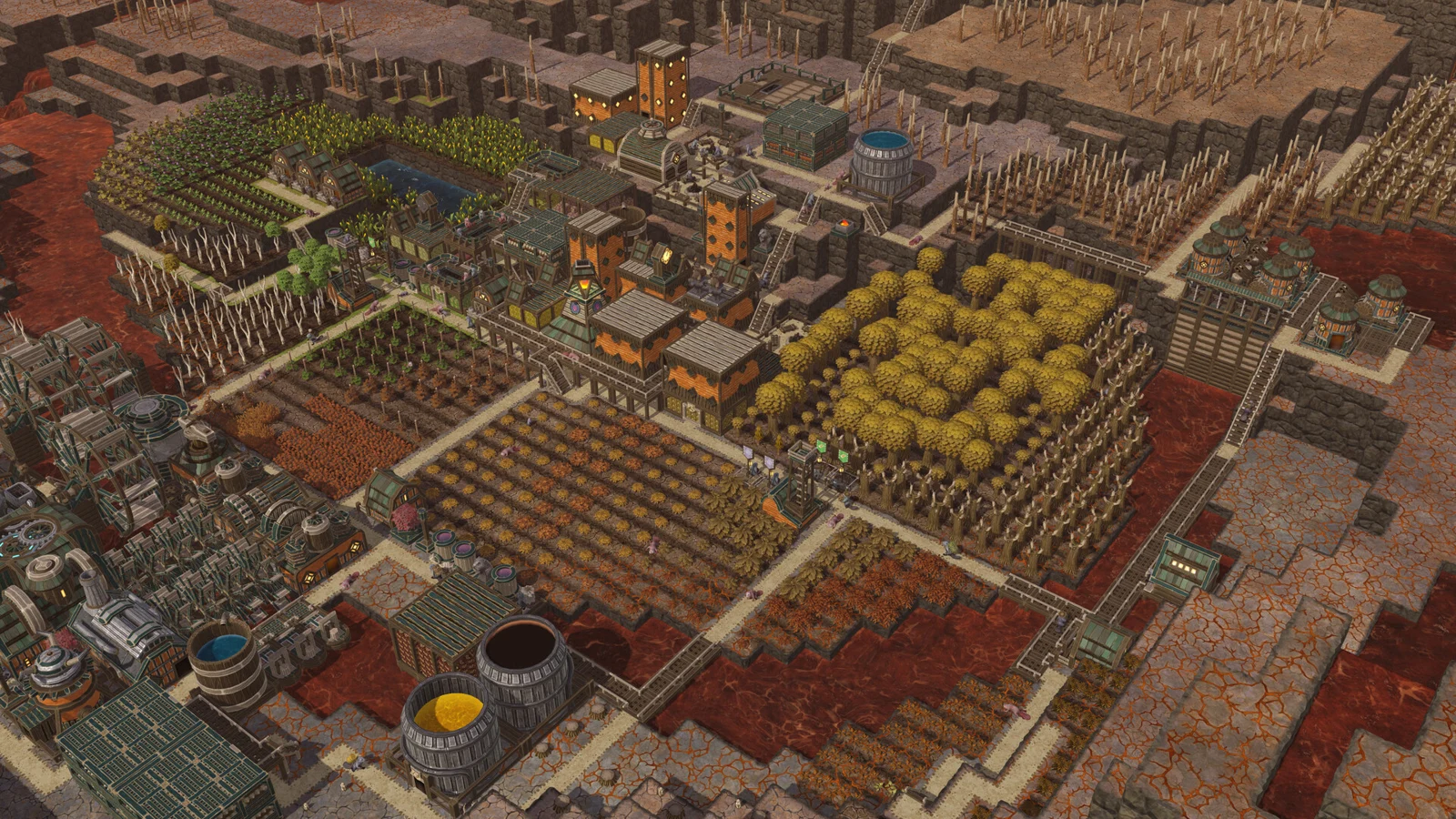
Begin with the land you want to serve
A channel is most useful when its route follows a purpose. Look at the area that needs water before drawing a long, attractive line across the settlement. The terrain, existing paths and planned production all influence where the canal belongs. A short route that supports a real district can be more interesting than a large excavation with no clear recipient.
Describe the intended service: water beside a growing area, a connection to a reservoir or a controlled branch through a neighbourhood. That description will help you judge the result after construction. Without it, almost any wet channel can look like success, even when the surrounding land still does not function as you intended.
Read height before length
A plan viewed from above can hide the important part of a water route: its vertical relationship with the source, basin and outlet. Rotate the view and inspect the levels before committing to a long construction. Timberborn's water and terrain systems reward thinking about the space as a volume rather than a flat drawing.
Do not assume a channel will receive useful water simply because it touches another wet area on the map. Follow the intended movement through the actual terrain. Where does water enter, what contains it and where can excess go? Those questions keep the project connected to the river instead of treating a new excavation as a separate decorative feature.
Preserve a route for the colony
A water project also changes how the settlement moves around the land. Consider crossings and access while the channel is still a plan. Production areas need useful connections, and a new strip of water should not accidentally turn a short working route into a long detour. Infrastructure is more enjoyable when it supports the everyday colony as well as the water experiment.
Keep crossings legible. A few intentional places to move over or around the channel make a neighbourhood easier to understand than improvised paths added after the fact. The canal can become a spine for the district: water on one line, useful working edges beside it and clear points where the rest of the settlement connects.
Test the first section before the full extension
Build a manageable part of the route and inspect how it behaves before extending the same assumption across the landscape. Watch whether it receives water as intended and whether the nearby land gains the service you wanted. A shorter experiment makes an incorrect height or outlet choice less costly to understand.
If the result is useful, the next section can build on an observed relationship. If it is not, change the part that caused the uncertainty. This is a more informative process than completing a grand channel and then wondering which of several simultaneous design choices made it awkward. The construction becomes a series of readable decisions rather than one oversized guess.
Let the banks become a district
Once the water route works, use the banks to give the area an identity. Keep productive space, paths and views aligned with the actual function of the channel. Decoration can reinforce the route instead of obscuring its maintenance and access points. A successful canal experiment ends with more than water in a trench: it produces a piece of settlement where engineering and daily movement now make sense together.